
Former state AG argues legal system is ‘broken’
Trending
Ernie Preate had it all -- power, prestige and a political career that seemed headed for higher offices. But that all ended when he was sent to prison for mail fraud for accepting illegal campaign donations.
Preate began his life in Northeastern Pennsylvania, the son of a successful lawyer. He attended public school in the lower grades and then moved to a private prep school. He graduated from Wharton School at the University of Pennsylvania and then the University of Pennsylvania Law School in Philadelphia.
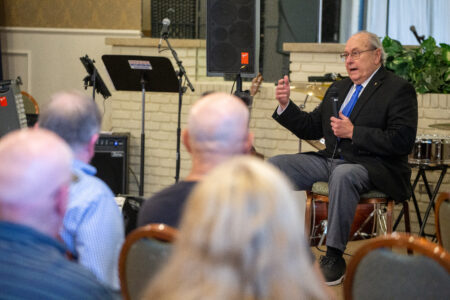
"I enjoyed my educational opportunities like lots of people do," Preate said recently, speaking to members of the Yokefellows Prison Ministry at their state convention in Williamsport.
"I became ready to go out and practice law, and then the guy named McNamara said, 'Come over here, boy, you're going to go to Vietnam,'" he said.
Preate joined the Marine Corps as an officer rather than waiting to be drafted. In January 1967, Preate was on a ship with other second lieutenants and about 3,000 other Marines, headed for Vietnam.
After arriving in Vietnam, Preate was assigned to a weapons platoon, to "try to learn how to be a commander of men," he said.
"They said they put me in this so you could learn how to duck bullets," he said.
Preate shared about his time in Vietnam. The harrowing experiences of walking through a rice paddy while under heavy fire from the enemy.
"My mother gave me a rosary. I was wearing it around my neck. I was praying the Rosary. It was 2:30 in the morning, bombs are going off. There was a little candle for light and it's sort of flickering," Preate said.
"This old Master Sergeant turned to me and said, 'What are you doing, kid?' and I said, 'I'm praying the Rosary.' I said, 'I don't know what I'm doing here.' I said, 'Sarge, is this the way it always is?'" he said.
When the older soldier told him, "no, this is bad," Preate said he asked him "how bad is it?"
The sergeant told him it was as bad as Iwo Jima during World War II.
"The point being, I started praying a lot and started leading my men in thanks for every minute we had," he said, adding that they never knew what they might encounter.
But, he made it through that life changing experience and returned home, eventually being elected as the district attorney for Lackawanna County.
"I was a pretty fierce prosecutor," Preate said.
He would later go on to be the state's Attorney General.
Preate's history included arguing two cases before the Supreme Court -- one on the death penalty and the other on abortion. He also put people on death row.
"I wrote a book about how to put someone on death row. I used to teach people all over the country. I was the prosecutor, the quintessential prosecutor. They had me on national television talking about the death penalty," he said.
"I was teaching other lawyers how to get the death penalty all across America. And then I got elected Attorney General in '89...one of the first things they did was argue the constitutionality of Pennsylvania's death penalty law in the United State Supreme Court," he stated.
He argued that the state's law was constitutional and helped to draft that law. He also helped draft mandatory minimum sentences and longer prison sentences during his career.
"I did all of that, not realizing what the personal impact was going to be on so many people who were defendants, some people that were family members. I was concerned about the victims, concerned about the police, concerned about law and order in the community," he said.
"But, I didn't have a sense of the impact of how what I was doing was having on people who were charged with crimes. And so, I was so strong in my beliefs that I couldn't be shaken. I was the leader of that," Preate said.
So, how did the ultimate prosecutor Ernie Preate end up an inmate in a prison in Minnesota?
Money collected at a fundraiser he had was over the limit of the amount of cash allowed by law.
"The point being, I violated the law and I accepted responsibility for it. I went before a federal judge in Harrisburg...so I had to admit my guilt, which was very humbling and a very difficult time for myself and my family," he said.
Preate's father, who was in the hospital on his deathbed at that time, urged him to fight the charges, but he told him he was going to plead guilty.
"It was hard, when you're at the pinnacle of prosecution in Pennsylvania, certainly, and maybe in America. I was the chairman of the Criminal Law Committee of the nation's Attorney Generals," Preate said.
"I used to meet regularly with Bill Barr...Mueller from the investigation of (former President Donald) Trump -- I used to know these guys, have dinner with these guys, and now I'm falling, falling. Our names across the newspapers, names on the TV, social media which had just started then. It was humiliating and hurtful," he said.
Preate accepted full responsibility for his actions and went before a judge for sentencing, where he was sent to prison in Minnesota.
"The important part of the story is that I accepted this. I never said to God, take this away from me. I never said that. I said give me the strength to deal with the indignities and humiliation that I was now going through," Preate said.
When he arrived at prison, mid-winter, he was standing in the "chow line" when God revealed to him what He was going to do with this total U-turn Preate's life had taken.
"I'm going to show you what you created," Preate said God said to him. Turning, he saw that one side of the room was people of color, brown and Black, and on the other side were the white people.
"I'll never forget. I realized that our system was broken. We were over-incarcerating people of color," he said.
His experience, he said, allowed him to see lawbreakers as people and not just numbers. He also noticed that prisoners were sent far from loved ones, just as he had been.
"I could see what the government was doing to separate families that provide support. They never had any visitors," he stated.
"And so I was really touched by their plight, and I got to be more involved with the prisoners," he said.
Preate served 11 months and 15 days in prison, where he said he made lots of friends and never really had a problem.
Before he left, Preate said that the leader of the Black community invited him to meet with his group.
"They said to me, you can change things. You see what's happening to us. You've got to be our voice because nobody listens to us, but you're the voice of the prosecution," he said.
"'They'll listen to you. They'll listen to your insights. They need to see what you've seen. You take that and do it for all of us and for generations to come.' And that was the opening of my work of prison ministry," Preate said.
Preate started looking at the laws from a different perspective.
"I changed, the law didn't change," he said.
"I'm hearing these cases, and I'm seeing the terrible, terrible job that lawyers are doing to defend these people," he said.
Because of the lack of resources and education on the other side, Preate could see the disparity between the defense and prosecution in cases and for this reason, even though he had argued in favor of the death penalty in the past, Preate stated that he believes it will eventually be banned in this country.
"My views have evolved almost completely. I'm against mandatory (sentences). I want the judges to have more discretion. I'm against these long probations which have people staying on probation for years for a drunk driving case," he said, the passion of his beliefs evident in his words.
"We have these mandatory sentences that make no sense. Let's try to eliminate those as much as we can because most of those sentences fall on the backs of people of color," he said.
"There's something wrong, is what I learned. I saw with my own eyes in the prisons," he added.