Geisinger Health Danville breaks ground on new behavioral health center
-
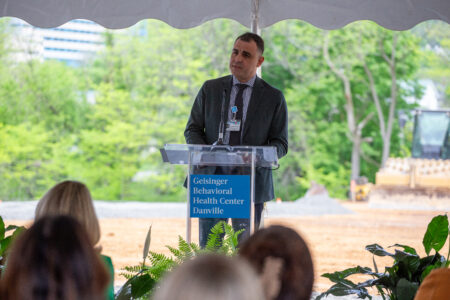
- KAREN VIBERT-KENNEDY/Sun-Gazette Imad Melham, MD., talks about the new Geisinger Behavioral Health Center in Danville during a groundbreaking ceremomy Tuesday.


-
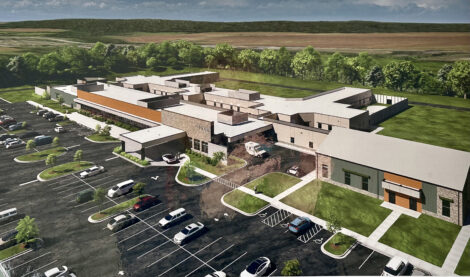
- PHOTO PROVIDED A rendering of the Geisinger Behavorial Health Center in Danville, which is slated to open in spring 2025.
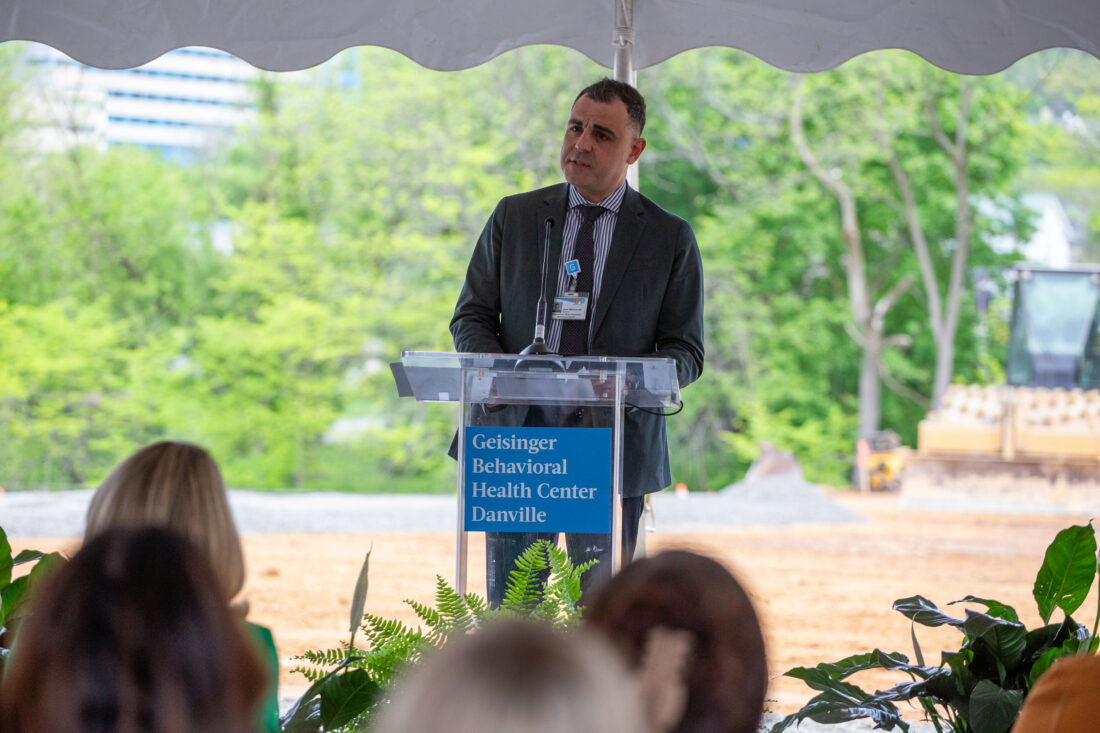
KAREN VIBERT-KENNEDY/Sun-Gazette Imad Melham, MD., talks about the new Geisinger Behavioral Health Center in Danville during a groundbreaking ceremomy Tuesday.
DANVILLE — Against a backdrop of earth-moving equipment, ground was officially broken for the Geisinger Behavioral Health Center Danville. The 96-bed behavioral hospital is set to open in spring of 2025.
In her opening prayer, Sister Barbara Sable, president of the Sisters of Saints Cyril and Methodius, said, “Help us to identify mental illness as the disease it is, that we might have courage and wisdom in the face of ignorance and stigma. Inspire us as we seek to overcome fear, acquire knowledge and advocate for compassionate and enlightened treatment and services.”
Geisinger will operate the facility as a joint venture with Acadia Healthcare Company.
The new center, located on land purchased by Geisinger from the Sisters, will be a standalone hospital, “focused purely on mental health and substance use and the co-morbidities that come with it,” according to Dr. Imad Melham, chair of Psychiatry and Behavioral Health at Geisinger.

“It really is one of the better approaches because it helps the patient to get the spectrum of care that they need,” he added.
The facility will have outpatient partial hospitalization programs, intensive outpatients programs as well as inpatient care. Electroconvulsive therapy will be among the procedures offered.
“It offers multiple layers. It treats the patient with the grace and respect that they need, whether it’s the design of the facility, whether it’s the processes that give the patient a smooth transition from coming in, getting the treatment they need and the involvement of the parents and the loved ones in the treatment planning,” he said.
“All of these make it really a state of the art center of excellence,” he added.
Partial hospitalization involves groups that are designed for patients that don’t necessarily need inpatient treatment but benefit from intensive treatment in an outpatient setting.

“They can come every single day or three times a week to get groups in the morning, etc., so it’s almost like a step down from the inpatient treatment,” Melham said.
Of the 96 beds, 24 will be for children and adolescents.
“We don’t have any of those beds in the area here, so it will be really meeting the demand or the need that our community has,” he said.
Treatment at the behavioral center is not designed for long term or acute care, which would involve months and months of hospitalization.
“There will be patients who, for many reasons, may not have the appropriate housing, the appropriate connection with outside resources, who may stay a little bit longer, but long enough until our team is able to help them with those aspects,” he said.

PHOTO PROVIDED A rendering of the Geisinger Behavorial Health Center in Danville, which is slated to open in spring 2025.
“Really, treatment cannot happen unless there’s a continuity and so having the team connect patients with the resources they have is key in this case,” he added.
Melham, speaking after the ceremony, touched on the fact that there are barriers to the access of mental health treatment that are bigger and unique to rural areas. Some of those barriers he cited are a lack of internet for telehealth and difficulty in finding transportation.
“So there are multiple barriers related to the rural type of living and the lack of availability, sometimes of the resources meaning, if we think about Geisinger and the footprint we serve, it’s really medically and psychiatrically underserved, even though it’s not identified officially as such, but our patients they wait a long time to get into to see one of the therapist or one of the psychiatrists,” he said.
Melham noted that suicide rates are almost double in rural area compared to some urban areas. Geisinger is expected to hire more than 100 team members to staff the new behavioral center, Melham said.
“Each unit will have a core of nursing staff, case managers, therapists, doctors, nurse practitioners, and with a team based approach to care,” he explained.
Geisinger had previously partnered with Acadia to open a behavioral health center at Moosic, where, according to Dr. Terry Gilliland, president of Geisinger Health, “every one of those beds gets filled just as soon as its available.”
“It really demonstrates the need for behavioral health in our communities, because it really has become a national problem,” Gilliland said.
“Right now 56 percent of all adults would say that they have a mental health problem that needs to be addressed and only three out of five can actually access care in a timely fashion,” he added.
This can result, Gilliland said, in someone taking things into their own hands or else they end up in emergency rooms which are already backlogged where they can end up waiting for days and sometimes months to get the care they need.
“It displaces people that actually need to use those services for things like a heart attack, or for lung failure or whatever the case may be,” Gilliland said.
“What this facility does, it allows us to take those patients and move them into a place where they can get the care that they need,” he said.
“It’s staggering to think about what we need to do in order to address, really, what is a mental health crisis in our time,” he said.
Top News

Montoursville’s Class of 2026 contemplates resilience

Sun-Gazette, Community Arts Center to present Army Field Band in concert

Williamsport’s graduates urged to seize the day
Firefighters fight blaze at Lycoming County Landfill
Yet another blaze broke out at the Lycoming County landfill in Brady Township. Firefighters and the Lycoming ...

Repasz Band celebrates national milestone with summer concerts