
Partnerships celebrated at new Habitat for Humanity site
Trending
Almost 60 years after students at what was then the Williamsport Area Community College (WACC) built a house on Fifth Avenue, another home was dedicated that the current generation of students at the Pennsylvania College of Technology designed and built, in the process earning real-life hands-on experience. Ironically, both houses are on Fifth Avenue, although neighborhoods apart.
The newest construction project was through the Greater Lycoming Habitat for Humanity and sits on the site of what had been deemed a nuisance bar, located on Fifth Avenue.
For Penn College student Nick Deremer, working on the project appealed to him because of the opportunity to collaborate with other students across various disciplines.
"When I first learned about the Habitat house project, what excited me most was how many different majors could come together and contribute. It really shows the power of partnership, everyone bringing their own skills and working toward one common goal," Deremer told the group which had gathered under gray skies to dedicate the new construction.
"This wasn't just about building a house, it was about learning how to collaborate the same way professionals do every day," he added.
He shared that his role in the build included site preparation, layout, exterior roofing, exterior finishing, roof construction, roofing and trim carpentry.
"Being involved in so many stages gave me a better understanding of the full building process and how each part connects to the next. I had the opportunity to work with other students and learn different techniques from our professors, which really helped expand my skill set," he said. "This experience sharpened my abilities in a lot of ways. It improved my technical skills, but just as importantly, it strengthened my communication and teamwork on a real job site, things don't always go as planned, and we definitely had moments where we had to stop, rethink and adjust. Working through those challenges with my peers taught me how to problem solve, manage time and stay focused on the end goal," he said.
He admitted that one of the most memorable parts of the project for him was seeing the day to day progress from the "early layout stages all the way to the finished details.
"Watching it all come together, and knowing that we as a group of students had a part in every step is something you don't forget," he said.
For a young man, who noted that he became interested in the construction field in the ninth grade, the experience gained in working on the Habitat Humanity house helps him "design the career I've always wanted after graduation.
"I plan to manage construction jobs and eventually start my own business. Being part of this project has given me confidence, real world experience and a clear understanding of what it takes to lead and succeed in this industry," he said.
"Looking back, what I'm most proud of is the collaboration between all of us, and most importantly, the overall finished product. We didn't just build a house. We built something meaningful as a team, and even more importantly, we helped create a home that will make a difference in someone's life," he said.
That sentiment was echoed by Libby Glunk, board treasurer for the local Habitat for Humanity.
'Today isn't just about dedicating a house. Because a home is never just four walls and a roof. It's where a family can finally feel safe, find stability and start putting down roots," Glunk said.
"This home is also a great example of what happens when missions align. Habitat is focused on creating affordable housing, and Penn College is focused on providing hands-on learning for its students. Together, that partnership created something meaningful for everyone involved," she said.
"This house becomes a home because a family will live here and build their future here," she added.
During the 1960's and 70's, students at the former Williamsport Technical Institute and WACC built six homes in the Williamsport area, which Michael Reed, president of Penn College, referenced this history in his comments at the event.
"For more than a century, Penn College and its predecessor institutions have adapted to workforce needs, cultivating the next generation of industry leaders. Our pioneering spirit began in 1914 as a vocational technical program that gained national acclaim for efforts to fight joblessness during the Great Depression and grew into the world renowned Williamsport Technical Institute. In 1933 the school needed a new machine shop, and local families needed food for their tables. Then President Dr. George Parks secured Public Works funding to offer food baskets to volunteers who helped to build the foundation of our new machine shop," Reed said.
"This can-do spirit continued in the 1960s when Williamsport Technical Institute classes built a home in the community. Guided by our hallmark applied technology education, our students and experienced faculty contributed from concept to completion of five more homes over the next decade," he said.
When the Fifth Avenue property had been labeled a nuisance and the business shut down, the college purchased it in 2015.
"Thanks to strategic partnerships, a property once labeled as a nuisance has a new life, now offering housing to a deserving family. Thanks to collaborative conversations with Greater Lycoming Habitat for Humanity, our city and county leadership, a challenge became an opportunity," Reed said.
"Students developed workforce ready skills, the property returned to the tax rolls, and a family has access to sustainable home ownership to raise the next generation within our community," he added.
Williamsport Mayor Derek Slaughter also spoke during the event, citing the need for more housing in the area.
"Housing is one of the main issues that we deal with here in Williamsport, Lycoming County and across the country, and it's partnerships like this one right here-and I was just on a call another day where we were talking about housing and being innovative- and I think this is one of the areas where you'll start to see this as a blueprint of partnerships happening to address the housing crisis, particularly in third class cities, where we are landlocked and there's not a lot of land to build," Slaughter said.
"The students didn't just design a structure or a home here. They built opportunity and stability and hope. They brought the classroom knowledge into the real world, working side by side to create something lasting. Our state and city and county, we help lay the groundwork, ensuring that projects like this can thrive and continue, and Habitat reminds us that safe, affordable housing...is not just a need, it's a foundation for stronger families and brighter futures,' Slaughter said, adding. "and this home will absolutely have a ripple effect. It will strengthen this neighborhood and remind all of us that community isn't just where we live, but it's what we build together. This house will be filled with joy, resilience and countless memories."
County Commissioner Scott Metzger also spoke of the need for partnerships within the community in order to accomplish things.
Housing was one of the areas that the commissioners decided would be a critical investment for some of the ARPA (American Rescue Plan Act) monies that were allotted following the pandemic. The project on Fifth Avenue received some of those funds.
"We stress community here today, and through the community, through the partnerships each one of these young individuals are going to embark on their future," Metzger said.
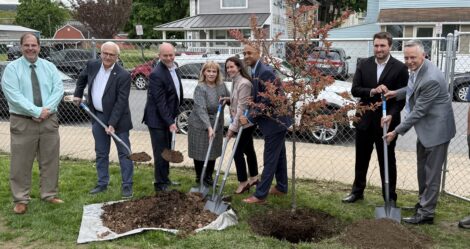
Instead of cutting a ribbon, marking the dedication of the house, students and faculty from the horticulture department planted a crab apple tree in the front yard of the property.
"It was grown by students in a containerized plant production class, while the planting was prepared by Professor Carl Bauer Jr. in his landscaping design class," Reed noted.
'Thank you for sharing a piece of your classroom to complete the project-planting the roots to signify a new beginning," Reed added.