
‘Very big expense’: City of Williamsport hit by $1.7 million bill for Bowman Field lights
Trending
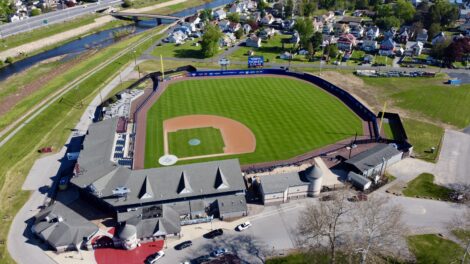
The City of Williamsport will need to cover the cost of a $1.7 million construction contract to replace the lighting at Journey Bank Park at Historic Bowman Field, home of the Williamsport Crosscutters, which begins its season next month.
The contract with Musco Sports Lighting was approved by City Council, but not before a lengthy discussion at its meeting on why and what is being done to cover the cost, which one councilman said was not in the budget.
About three weeks ago, Scott Livermore, director of the city Public Works Department, said he received a call from an "individual that found some bolts on the ground."
Upon further investigation, the western side, on the third base side, he said, the lights sheared off bolts and that was deemed to be unsafe, so Livermore said he had an inspector come in, look at that pole, and upon further evaluation of another pole, which was rusted and "on the brink of coming down," he and Mayor Derek Slaughter determined it was necessary to remove the light poles for this safety issue.
"Rather it happen that way than some catastrophic way," said Council President Eric Beiter.
"The timing is unfortunate," Livermore said. "It needed to happen. It happened right now, I guess."
The old poles at the ballpark were installed in 1987. The city took down eight with eight new ones going back up.
Musco offered two different payment options. The first, which was approved and can be amended if necessary, is paying $500,000 upfront, a $500,000 payment in November, and the remaining balance due on Jan. 1.
A second payment option is $500,000 due upon start, $500,000 in November, $377,600 in July 2027 and $377,600 in July 2028, which due to financing terms would be $31,000 more that the first option.
Beiter asked if there were questions from the rest of council.
"I can think of one – how is this going to be paid for?" he asked. "It's a very big expense," he added.
"One that's not in the budget," Councilman Vince Pulizzi said.
Payment plan
Valerie Fessler, the executive director of the city Department of Community and Economic Development, noted that state Rep. Jamie Flick, R-South Williamsport, has pursued $500,000 in state funding for the project, which the city anticipated to be awarded any day now.
"We are just waiting for the official paperwork on that," Fessler said.
Additionally, the city received a $750,000 in a sports marketing and tourism grant specifically for doing improvements at Bowman Field, she said.
While there were significant improvements made, there is $293,000 remaining in that grant, she noted. Rather than pursue the last few items on the Bowman Field list, the revised plan is to reallocate those funds to cover this project because of the urgency, she added.
As for the funds that would remain, that is $893,000 to be committed towards the $1.7 million lighting project.
Fessler added that it was her understanding there are additional conversations with Flick occurring between the representative and Gov. Josh Shapiro and his administration that are going "positive," she said, clarifying that she had not heard about any commitments as a result of those conversations but as a backup to them, yet another funding source could be available.
It is from the city program income from a housing initiative in the 1990s, she said. A housing redevelopment assistance program grant that was received in the 1990s can be used toward this lighting project. There were affordable housing apartments built and as part of that the city attached a mortgage to that project. Since then, the developer has been paying the city back.
"We have other plans for this funding?" Councilwoman Liz Miele asked.
"There are things we could do with this funds, yes, where we are able to spend it elsewhere and that is why we are seeking this other legislative funding in hopes that could be used instead of tapping into this program income," Fessler replied. "It would be an eligible expense based on the program guidelines and review by the city consultant.
"It is available but we are certainly using it as our last option," Fessler said. "We have been successful with other sports marketing and tourism grant funds," she added. "It seems to be a priority to keep the Crosscutters up and running and we are willing to offer it as an option for this project."
Caliber of lighting
"I am assuming the lighting we are installing is of the caliber required by Major League Baseball?" Miele asked.
"It's up to Major League Baseball standards," Livermore said. "It's not so much required... I guess."
"They've (MLB) been bringing in their own lighting, correct?" Miele asked.
"They won't have to any more," Livermore said.
"Do we need to make the decision about how we are paying for these when we sign the contract tomorrow (Friday) or can we make that decision down the road?" Miele asked.
"We don't have to have our funding sources for November set" on Friday, Livermore replied, referring to the $500,000 and the potential for the $293,000 "left in the grant to get us going." The city has until November to get the next funding source of $500,000.
"We do have that funding lined up if we need it," Miele said.
Former council president Adam Yoder weighs in
Yoder said he appreciated Miele asking the funding question.
"To be candid it's in the back of my mind," he said. "As uncomfortable as I am approving this without everything lined up I don't know that we've got much choice. I don't want to put the Crosscutters in a bind. I really appreciate what they bring to the community. When you think about a location for people to gather, to build community, that kind of thing, they do a lot in that regard and we are fortunate for it," he said.
"I think this is one of those exceptions where we can stick our necks out and think through it." Yoder said adding that he appreciated Livermore jumping in on this urgent need and, while he had reservations before about some aspects of the CoStars bidding system, this contract for the project can be done in a fairly fiscally-responsible way, he noted.
Kudos to the quick response
"You grind," he said of Livermore. "You work hard. This is a big one – appreciate you getting your hands dirty and figuring something out here."
Livermore acknowledged that it is not the perfect situation but the city was handed an emergency three weeks ago.
He acknowledged how the Crosscutters' season is right around the corner. Once the phone call was made, Musco was at the stadium within three days checking the situation and had the poles down, he said.
"They had a crane here they brought in from Virginia," Livermore said. "They moved real quick to get this safety issue taken care of right away. Now they are helping the city out the best way it can, providing the two payment options.
Funding asks
Yoder also added his appreciation to the state legislators who, over the years, have come to the table to assist the ballpark, the team and the city.
"When we start thinking of funding, I'll be the one to say it, I think there is an easy ask of MLB to help out here, right?" Yoder asked. "They benefit from this. They have been at the table in the past and have publicly told me in prior meetings, when I was in your chair (referring to Beiter), that how much they value the partnership," Yoder said. "This is a really great opportunity to deepen that and I think that they do."
"In talking with the mayor, I know he has reached out to MLB," Livermore said. "I don't know the conversations back and forth, but I know they are aware of the situation, and I think that they are seeing what they are able to help out with, so I don't know what that is right now," Livermore said.
"Hopefully, they can help, and they (the league) can help sooner than later," Yoder said, adding if there hasn't been that kind of request to the league that he hoped it could be made and the league would consider helping out.
Councilman Jon Mackey seconded the thoughts about the Crosscutters.
"Obviously, this is what needs to be done because of what the Crosscutters bring to the city," Mackey stressed. This will be league-standard lighting and he surmised that in some point in the near future MLB would have come to the city and said it had to be done if it wanted the MLB Classic to continue.
The Classic has become a tradition for the league and is held in August during the Little League World Series in South Williamsport. The game is a spectacle that is broadcast on television and allows world series participants and their families to watch a regular season professional game and interact with the players at the Williamsport Regional Airport arrival, and on the ride over, hours before at Volunteer and Howard J. Lamade stadiums at the complex in South Williamsport, and right before the game at the city-owned ballpark.
"Should Major League Baseball be helping us pay for this?" "Absolutely," Mackey said, adding he would also ask the administration to reach out to Little League International. "Who else benefits from this game? Little League does. This game is a three-hour commercial for Little League Baseball."
Livermore noted the mayor has done that also, but, again, said he was not familiar with that conversation.
"I would, publicly, ask Little League Baseball to talk to somebody," Mackey said. "Let's figure out how they may be able to help financially with these lights."
One other item not discussed is the Crosscutters' schedule.
The team starts June 2 and it was Mackey's understanding that the lighting is definitely not going to be done by then and that temporary lighting for those three games would be needed because they cannot play – whether it is day game or not – they cannot play without lights.
"You cannot have baseball players out there if it gets overcast. Whatever it is." Mackey said.
There is a cost to that – so where is that money coming from? Mackey asked, doubling up his question – "What kind of guarantee do we have that the lights will be ready by June 12?"
Livermore confirmed he had not received such a guarantee, but had discussions with Musco and the other contractors that they are going to do everything they can to make it happen by the first pitch.
So far, they have been more prone to say by June 12 versus June 2 because of the time constraints but they are not giving the city a time other than June 12, Livermore said.
Mackey continued to pry for answers.
"Sure, but we do need temporary lighting for those first three games . . . how are we figuring that out?" he asked. "MLB is saving money now because they don't have to bring in lights. Is that something in the interim that MLB could help the city out with?" he asked. "They would be spending on temporary lights for the MLB Classic that they won't be spending now they could help us out with this cost."
Statement on behalf of the team
"We've had discussion with Musco to bring in temporary lights," said Doug Estes, Crosscutters vice president and general manager.
"We'd basically have to sign an agreement ... $120,000 for those three games," he said.
"We are in the same position, I think, the city is in trying to figure out how to pay for that," he said.
"Our goal ultimately is to have a discussion with the mayor as soon as this project is given the get-go," Estes said, before the vote. "Obviously, if this project is not given the get-go we are in, basically, in violation. We can't play our season. So, according to our lease, I think it's important that these lights get in as soon as possible," he said.
"But again, we are trying to figure it out," Estes said. "We have some ideas and I'd like to have a meeting with the mayor to discuss them further before bringing it to council."
"While replacement of the lights was part of a five-year renovation plan, nobody could have foreseen this happening just a handful of weeks before our season," Gabe Sinicropi, vice president of marketing for the Crosscutters, said Friday. "The Cutters would like to thank everyone in the administration and city council for their swift action on this important project. We are also indebted to Rep. Flick for his work on the state level for funding along with Sen. (Gene) Yaw. At a ballpark built on a century of memories, these new lights will ensure the next generation shines even brighter."
Mackey thanked the team for all of its behind-the-scenes work to try and figure this out.
Mackey also publicly said thanks to Musco Sports Lighting for working with the city.
"I think they also understand the importance of this," he said.
Energy efficiency
Councilman David Dussinger, an engineer by profession, said he assumed these lights to be installed will be a lot more efficient than what is to be ripped out, asking if the city pursued any potential rebate programs.
Livermore said he had not gotten that far but he surmised there would be a reduction to the electricity bill based on the quality of the new system.
Light pollution and pre-set light shows
These are lights that will have a downward projection and do not present the neighbors with much light pollution, Beiter noted, as he reviewed the contract. It appears that they also can be pre-set for light shows, which the council president said could afford guests even more entertainment at the ballgames.