The Seminary in the Wilderness: an early school for women
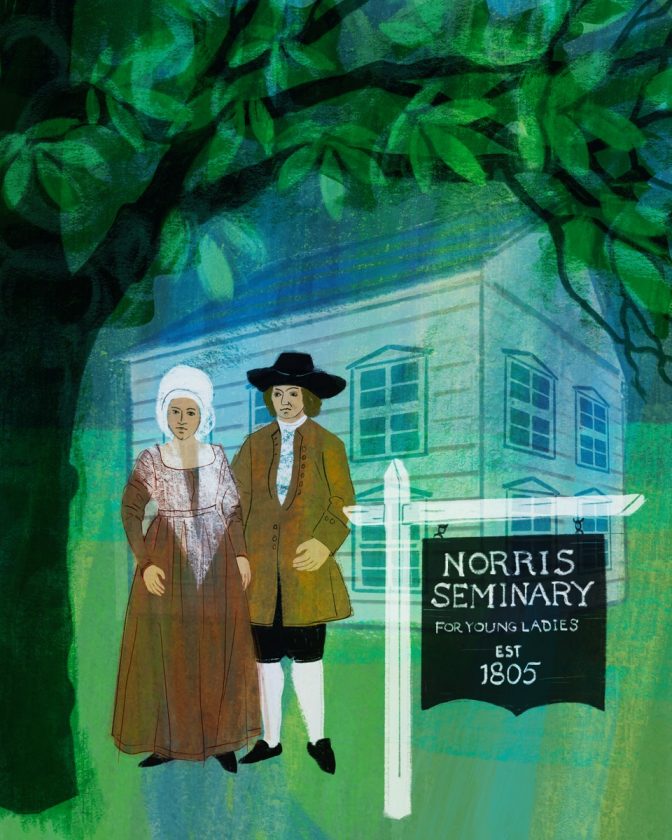
PHOTO PROVIDED A drawing of the Norris Seminary in Pine Township by Kate Anderson.
In 1805, a Quaker couple, John Norris (1768-1849) and his wife, Beulah Jackson Norris (1793-1869), settled in the wilderness of Pine Township, in the far north of Lycoming County, and established a boarding school for girls.
At first called the Norris Seminary, it soon became known as the Seminary in the Wilderness. Teenage girls from Williamsport, Montoursville, Jersey Shore and other settlements along the Susquehanna made the journey to attend the school, the only place in northern Pennsylvania that young women could further their education at the time.
(The word seminary can refer to an institution for the training of candidates for the priesthood, ministry, or rabbinate, but also simply, as in this case, an institution of secondary or higher education.)
State Road of 1799
The school was on the new state road that opened in 1799 and connected Newberry to Painted Post, New York. John Norris and his wife had bought land in Pine Township in 1800, just after the road was open. John Norris was born in England and was educated at Oxford University. Beulah Norris was from Philadelphia. John was a land agent for a Philadelphia man, Benjamin Wister Morris, and together they were promoting the development of the region.
The school was in the hamlet of Texas, which no longer exists as a town, but would be about 45 minutes northwest of Williamsport on today’s roads, not far from the towns of Navroo and Morris, and the Texas and Blockhouse Fish and Game Club.
One can only wonder what the trip took in those years — perhaps on a plank road or a narrow dirt road — in a horse and cart. There was no public transportation on the road until 1819.
Two-story house
The Norrises had a two-story frame house, divided into four square rooms on the first floor and a living space on the second floor. A two-story house was relatively unique for the time in Lycoming County. Both the Norrises and the boarding students stayed in the house.
Together, the couple administered the school and taught its classes. The school was established solely for the purpose of educating young women and was very successful. It was a bold venture for the time. According to John Meginness in the “History of Lycoming County” (1892), “some of the best young ladies of that day were educated at the wilderness seminary.” He mentions Ann and Hannah Blackwell, Maria Davidson, Jane Morrison, Priscilla Morrison and Elizabeth Porter. One aim of the school to was help the young women find good husbands, and in that, it seems to have succeeded.
Sarah Burrows Coryell
One of the Seminary students, Sarah Burrows (1793-1869), married Tunison Coryell (1791-1881), who began his career as a clerk to Sarah’s father, and later became a wealthy man “closely identified with the progress and development of Lycoming County for more than half a century,” according to Meginness.
Sarah’s parents were Gen. John Burrows, the founder of Montoursville, and his wife, Jane Torbert Burrows. Gen. Burrows had spent the winter with Gen. George Washington at Valley Forge, but this did not put him on the path to success. After having tried and failed at several business ventures, he “disposed of his tools and he took his wife and five children (one of them at her breast), and a bound boy, and started for Muncy,” where they moved into “a log cabin about sixteen feet square with another family of six children,” according to his autobiography.
Sarah Burrows was that infant at the breast. Her mother, Jane, died in 1804, when she was 10 years old. The family moved from place to place in Muncy Valley until 1812, when Gen. Burrows purchased the land that became Montoursville. There were few opportunities for education for Sarah.
Marriage to Coryell
After her marriage, Sarah and her husband moved into their new home on what was then Front Street, near the river at the foot of Pine Street in Williamsport. They celebrated their golden wedding anniversary at the same home, and Sarah died there in 1869. A writer for the Muncy Luminary commented at the time of her death:
“What changes have occurred in these fifty years. The rural village of a few hundred inhabitants in 1819, settled among the trees, with only here and there a cluster of storerooms for accommodating the people with their supplies in dry goods, groceries, etc., is today [1869] an inland city with its thousands struggling for life, wealth and position.”
Coryell died in that same home 12 years later in 1881. Among their many descendants is William Gibson, president of the Lycoming County Genealogical Society.
Elizabeth Ross
Another Seminary student was Elizabeth Ross (1790-1828). She was the oldest daughter of Michael Ross, the founder of Williamsport, and his wife, Ann Corsen. She was born just five years after Lycoming County was established.
In 1800, when Elizabeth was 10, Williamsport had 131 residents and no school buildings. The Ross family moved into an abandoned cabin.
She would have been 15 or 16 when she attended the Seminary in the Wilderness. In the collection of the Lycoming County Historical Society are books and journals that belonged to the Ross family, including a hand-stitched booklet of handwriting exercises completed and signed by Elizabeth.
Marriage to Vanderbelt
She was 19 when she married Peter Wykoff Vanderbelt (1786-1871). He was from one of the wealthiest families in Williamsport. The Vanderbelts lived on the eastern border of Williamsport, on Vanderbelt Street, now called Penn Street.
They had three children, Ann, Mary and William. Mary married William Packer, the 14th governor of Pennsylvania. Elizabeth Ross died in 1828 at the age of 38. The next year, Peter married Elizabeth Grafius.
After about a decade, John and Beulah Norris closed the Seminary in the Wilderness and relocated to Wellsboro. They are buried in the Wellsboro Cemetery with their daughter Cornelia (1807-1826).
The building that housed the seminary is gone now, and only some of the foundation stones remain. According to Harry Stephenson Sr., author of “History of Little Pine Valley” (Camp Hill, PA, 1992) only a few local residents know where the seminary once stood.
Sieminski is the former director of the Madigan Library at Penn College. Hurlbert is a Professor Emeritus of Library Services at Lycoming College. Sieminski and Hurlbert are founders of the Lycoming County Women’s History Project (www.lycominng.edu/lcwhp). Their column is published monthly, and they may be reached at lcwhcmanager@gmail.com.
Lifestyle News
Program portrays life of Revolutionary War soldier, painter
Uptown Music Collective accepting scholarship applications
The Uptown Music Collective, the area’s premier nonprofit school of music, is now accepting scholarship ...
Speakers at city library to discuss great dinosaur movies
The James V. Brown Library, 19 E. Fourth St., is offering a free program titled, “The Lost Worlds: Prehistoric ...
Library hosts ‘name the dinosaur’ contest
The James V. Brown Library, 19 E. Fourth St., is hosting a naming contest for its 2026 Summer Learning stuffy. ...

Laurel Festival returns to Tioga County