
Reflections in Nature: Examining why a buck has antlers and not horns
Trending
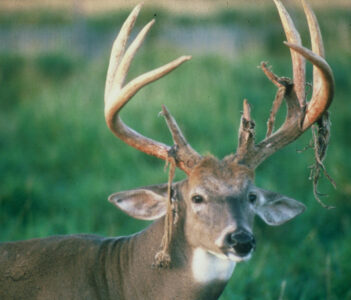
For the past week, deer hunters have been roaming through Penns Woods in hopes of harvesting a buck. But with the proper license, hunters were also able to harvest a doe. When discussing a buck's rack, the antlers are mistakenly called horns.
This is a misnomer since deer have antlers, not horns. The difference between horns and antlers is that horns are dead since they have no blood supply. Horns, which grow on both sexes of a species, are made of keratin, the same material that our fingernails are made of. Antlers are grown only on the male members of the deer family. The exception to this is the female caribou, which has antlers, however, two weeks after giving birth to her young, the female caribou sheds her antlers.
An antler that is growing is referred to as being in the velvet. In this stage, the velvet is somewhat likened to the branches of the staghorn sumac, hence the tree's name. An antler injured during the velvet stage will become overdeveloped and deformed, causing it to have either unusual curves or points. Biologists have learned that this antler will become deformed every year of the buck’s life
Biologists have also found that if the deer's antlers are in the velvet stage and the deer injures its right rear leg, the left antler will be stunted, and if the left rear leg is injured, the right antler will become stunted. However, any injury to a front leg will cause the antler on the same side to become stunted.
While growing antlers, a buck cannot obtain all the minerals (calcium and phosphorus) needed from its food. So the buck robs minerals from its own skeletal system, especially from the rib area. The antlers are growing at such a fast rate that much stress is put on the bones of the deer, with the ribs becoming brittle and easily broken. Once the antlers are finished growing, the minerals robbed from the buck's body are replaced.
Many Native American tribes had different attitudes towards white-tailed deer. It was thought that the characteristic forked antlers of white-tailed deer represented a forked or double nature. However, other tribes believed that white-tailed deer was an animal helper, while dark-tailed deer represented danger. One legend told was that mule deer could change into a beautiful maiden that lured young men to her. Then, she would switch back to a deer, and the young men would die. If by chance a young man survived the encounter, he would possess great powers for the remainder of his life.
According to Native American legends, deer received its antlers when a rabbit challenged the deer to a foot race, with the prize a set of antlers. After the race track was laid out through the forest, the rabbit asked if he could look at the path before the race. The other animals agreed to the request. When too much time was spent checking out the path the other animals went looking for the rabbit. The rabbit was found cutting brush to make a clear path for himself. The animals considered this cheating and awarded the antlers to the deer.
At birth, a young buck's antlers will immediately begin to grow. By the first fall, they will be small buds that are called buttons. After a buck's antlers are finished growing, the animal sheds the velvet on the antlers. This is done in conjunction with the amount of light. All bucks in the wild will shed their velvet in a three-week period.
All bucks will shed their antlers each year but not all antlers will be shed at the same time. In the wild, a buck could lose an antler one day and then lose the other antler several days or even weeks later. On one day, a buck’s antlers can't be knocked off, however, a day or two later, the antler could just fall off. After the buck loses his antlers, he loses his masculinity, interest in sex and will to fight. This can be likened to the Bible story of Samson and Delilah. After Delilah cut Samson's hair, he lost his strength; however, as his hair slowly grew back, he recovered his strength.
All hunters know that male deer fight during the the mating season. We now know by the time rutting season starts, the bucks themselves know who is the head honcho. At one time it was thought that he was the one who bred most of the does, however, we now know that this is not true. According to the Pennsylvania Game News, tests confirm that does breed with more than one buck and also that 20-25% of the time, twins aren't even full siblings.
White-tailed bucks do not have harems but do form a tending bond with does in estrous, staying with her for 24-48 hours. The majority of does come into estrous at the same time, which means hundreds of thousands of does need to be bred during a two-week period. A buck courts one doe at a time, leaving the door wide open for all bucks to find a doe in estrous.
Even as late as early March, some bucks can still be seen sporting their antlers. During the time a buck is capable of breeding, there are does coming into estrous, he will not shed his antlers. There are some bucks with antlers that appear white, while others sport antlers that appear dark. Some hunters say that the dark-colored antlers are carried by older bucks.
Not true.
The color of a deer’s antlers depends on what he is rubbing his antlers on during the rutting season. A buck will rub his antlers on small saplings. If the small sapling is a young hemlock tree, the antlers will become dark from the tree itself. If the young sapling is an aspen or young maple tree, the antlers will be whitened.
Whether called horns or antlers, a male deer sporting a nice rack will get the hunter’s heart pumping, which could lead to buck fever.
Bill Bower is a retired Pennsylvania Game Commission Wildlife Officer. Read his blog and listen to his podcasts on the outdoors at www.onemaningreen.com.